

Table of Contents
Sugar dating in Latin America is not a uniform experience. Two major cultural blocks define how these relationships are experienced in our region: the Caribbean, with its spontaneous and festive energy, and South America, with its more leisurely and reflective pace. Understanding these differences not only enriches your perspective, but can significantly enhance your experiences depending on the country where you find yourself or explore these dynamics. From tropical beaches to Andean metropolises, each zone brings its own unwritten code for how sugar relationships are built and maintained.
The Caribbean: spontaneity under the tropical sun
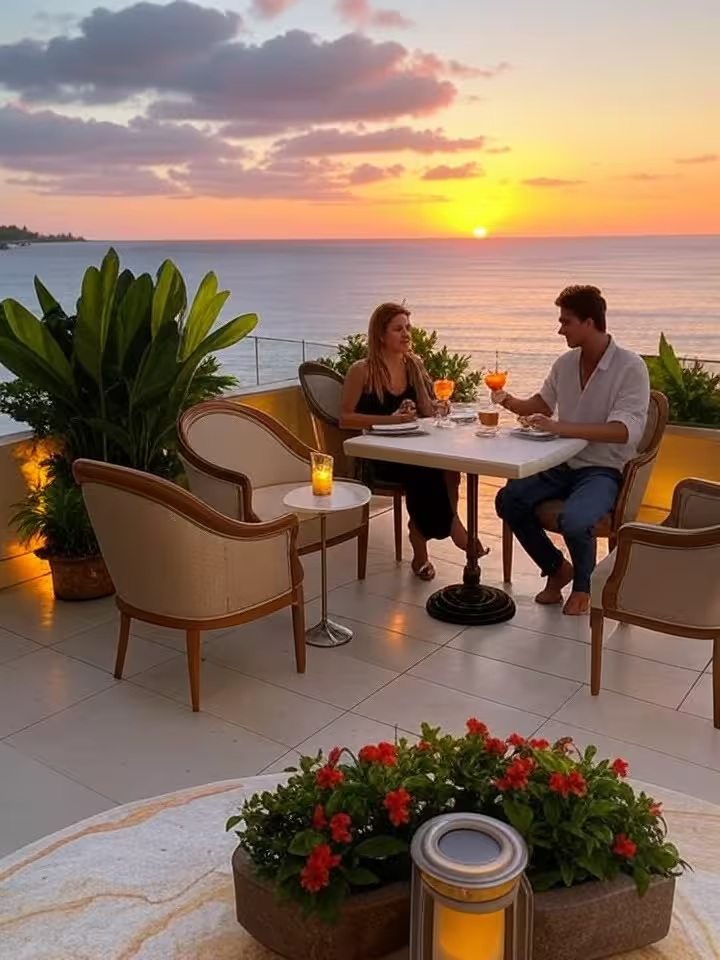
The Latin American Caribbean - which includes destinations such as Cartagena, Cancun, Santo Domingo, San Juan and Panama- imprints a particular stamp: human warmth translates into quick and genuine connections. The geography directly influences the style: the beaches, the constant climate and the colonial architecture create an environment conducive to relaxed encounters, without the excessive formalities that characterize other latitudes.
In these areas, dating tends to come naturally, almost improvised. A WhatsApp message can lead to a meeting the same afternoon on a terrace facing the sea. Bars, restaurants overlooking the ocean and seaside promenades are the preferred places to meet. Urban Latin music -reggaeton, salsa, bachata- accompanies the social environment, and it is not unusual for a sugar connection to lead to spontaneous plans such as attending a concert or local festival.
However, this openness coexists with a complex social reality. In countries such as the Dominican Republic, Puerto Rico and Colombia (Caribbean coast), family and social image continue to be important pillars. Catholic influence, though less rigid than decades ago, still sets certain expectations about relationships. For this reason, many people in the Caribbean prefer to keep their arrangements discreet, especially outside of the cosmopolitan tourist areas.
The tourism economy of these destinations also plays a role. Cities like Cancun, Punta Cana or Cartagena are used to receiving international visitors, which generates a culture more open to relationships outside the traditional molds. Caribbean beaches thus become ideal scenarios for those seeking sugar connections with a component of adventure and disconnection.
South America: depth of urban connections
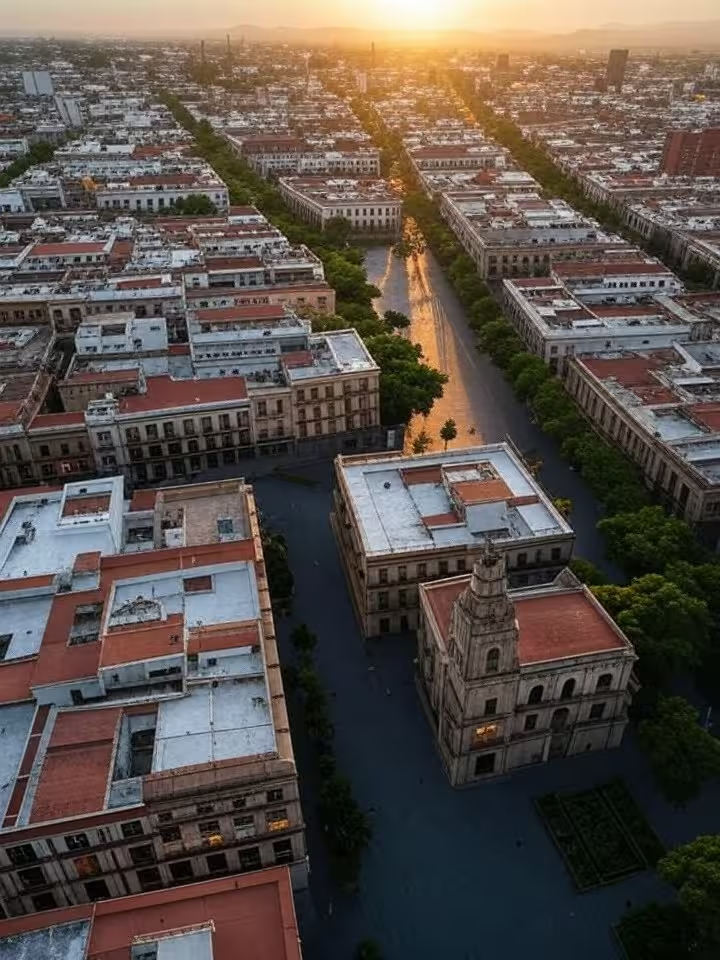
Crossing to the south of the continent, the panorama changes. Buenos Aires, Santiago, Bogota, Lima, Medellin, Montevideo, Buenos Aires, Santiago, Bogota, Lima, Medellin, Montevideo -The large South American capitals set a different pace for sugar dating. Here, relationships tend to be built with greater intention, with longer conversations and an emphasis on emotional and intellectual compatibility that complements physical attraction and financial agreement.
Appointments in South America usually take place in cafes, signature restaurants, art galleries, bookstores or cultural spaces. In Buenos Aires, for example, a sugar date can start with a walk through Palermo, continue with a coffee in San Telmo and end at a milonga. In Bogota, a tour of La Candelaria or a dinner in Zona G reflects this taste for experiences with cultural content. Conversation is the focus: politics, literature, cinema, local history - topics that in the Caribbean might take a back seat to the immediacy of the moment.
This depth does not mean coldness. Latin American warmth is present, The relationship is expressed in a different way: in the attention to detail, in the careful planning of meetings, in the genuine interest in getting to know the other person's life beyond the arrangement. In cities like Santiago or Montevideo, where the European influence is more marked, sugar relations adopt more formal codes at the beginning, although they become equally close once trust is established.
An interesting factor: the relative economic stability of certain Southern Cone countries (Chile, Argentina, Uruguay) allows arrangements to be more structured and long-term. Unlike the Caribbean, where tourist seasons mark peaks in activity, in South America sugar relationships tend to be maintained beyond the vacations or immediacy.
Of course, within each South American country there are important differences. Cities like Arequipa in Peru, or Cuenca in Ecuador, maintain more traditional structures than the capitals. Medellín and Bogotá, On the other hand, they have undergone an accelerated cultural transformation in recent decades, becoming more open and cosmopolitan, which is reflected in the way alternative relationships are experienced.
Caribbean style
The Caribbean favors spontaneity and immediacy. Connections are formed quickly in relaxed environments such as beaches, beachfront bars or festivals. Communication is direct, warm and often takes the form of impromptu encounters. Sugar relationships in this zone tend to be more casual and linked to leisure experiences, but always with mutual respect as a fundamental basis.
South American style
South America emphasizes depth and planning. Connections are built with extended conversations in cafes, restaurants or cultural spaces. There is greater emphasis on intellectual and emotional compatibility. Arrangements tend to be more structured and long-term, with communication that prioritizes getting to know each other well before moving forward. Sophisticated urban culture sets the pace for these relationships.
Common point
Despite the differences, both regions share fundamental values: mutual respect, honesty in expectations and discretion. The family maintains importance throughout Latin America, influencing how relationships outside of traditional marriage are handled. WhatsApp is the preferred communication tool in both cases, although with different uses depending on the region.
Cultural factors that make a difference
Beyond geography, there are deep cultural reasons that explain these differences in style. The Latin American Caribbean has a strong influence of African and European cultures mixed with indigenous traditions, which historically has generated societies more open to intermingling, physical contact and direct emotional expression. Music, dance and celebration are central elements of Caribbean social life, and this is reflected in how interpersonal connections are generated.
South America -especially the Andean and Southern Cone countries- retains a more marked heritage of Spanish colonial structures, where protocol, initial formality and social hierarchy still carry weight. It does not mean that they are closed societies, but it does mean that relationships are built more slowly, prioritizing trust before total intimacy. According to studies on Latin American culture, These differences can be traced back to centuries of divergent historical development.
Economics also plays a role. Caribbean countries are heavily dependent on tourism, This generates greater exposure to foreign cultures and, therefore, greater flexibility in local social norms. Cancun, Punta Cana or Cartagena receive millions of visitors annually, creating an ecosystem where non-traditional relationships are more accepted (or at least, less publicly questioned).
In South America, large cities such as Buenos Aires, Santiago and Bogota are the most important cities in the region. economic and cultural centers that do not depend on tourism as a mainstay. This allows them to develop a more stable cultural identity that is less influenced by external expectations. Relationships, including sugar, follow more deeply rooted local codes.
Another important aspect: the influence of Catholicism is transversal in Latin America, but its weight varies. In countries such as Mexico and Colombia, religion continues to strongly influence perceptions of relationships outside marriage. In Argentina, Chile and Uruguay, although the majority declare themselves Catholic, religious practice is lower and secularization is more advanced. This translates into greater openness to unconventional arrangements in the south than in the center of the continent.
How do you adapt your approach according to the region?
Understanding the differences is only the first step. Adapting to the local style significantly increases the chances of building genuine and satisfying connections.. If you are exploring sugar dating in the Caribbean, some practical tips include:
In the Caribbean:
Be flexible with plans. Appointments can come up on short notice, and that's part of the charm. Take advantage of outdoor spaces: beaches, terraces, boardwalks. The relaxed atmosphere encourages natural conversations. Don't be afraid to show enthusiasm or emotion-Caribbean culture values expressiveness. Respect discretion, especially outside of tourist areas. Many people prefer to keep their arrangements private because of the weight of social appearances. Use WhatsApp in an agile way: short messages, emojis, audios. It is the preferred means of communication and reflects the direct style of the region.
In South America:
Invest time in getting to know each other before formalizing the arrangement. Long conversations are valued and expected. Choose places with content: museums, bookstores, historic cafes, restaurants with history. This shows interest in local culture. Show genuine interest in topics beyond the arrangement: politics, art, history. Intellectual connection is important. Maintaining long-term interest requires depth. Be punctual and respect commitments. Initial formality is part of the social code. Use WhatsApp in a more structured way: full messages, less use of emojis in the early stages, more weight on the content of conversations.
Of course, these are general patterns. Each person is unique, Within each region there are huge variations depending on the city, the socioeconomic context and personal history. A sugar daddy from Medellín may have a completely different style than one from Lima, even though both are South American. The important thing is to remain culturally sensitive and adapt your approach according to the signals you receive from the other person.
The importance of social platforms and networks
Throughout Latin America, digital platforms have transformed sugar dating. Social networks such as Sugar Daddy Latam allow them to connect with people throughout the region, breaking down the geographic barriers that previously limited these relationships. However, the way these platforms are used also reflects the cultural differences between the Caribbean and South America.
In the Caribbean, profiles tend to be more visual: photos on beaches, outdoor activities, images conveying a relaxed lifestyle. Descriptions are shorter and more direct. Initial communication is fast - if there is mutual interest, you quickly move from the platform to WhatsApp and from there to a meeting.
In South America, profiles typically include more detailed descriptions, mentions of cultural interests, musical or literary tastes, etc.. The photos, although also important, are complemented by information that allows us to evaluate compatibility beyond the physical. The process from the first message to the face-to-face meeting is usually longer, with several previous conversations to establish trust.
Discretion is important in both regions, but it is handled differently. In the Caribbean, discretion involves keeping relationships outside close family and social circles, but not so much weight on total anonymity. In South America, especially in more conservative cities, discretion may involve greater care in public places, use of less identifiable profiles and more reserved communication.
Common mistakes in not understanding regional differences
Many people make the mistake of assuming that sugar dating works the same throughout Latin America. Some of the most frequent stumbling blocks include:
In the Caribbean: Arriving with an overly formal or structured mindset can be perceived as distant or inauthentic. People expect warmth and naturalness. Ignoring the local social context - for example, not understanding that outside of tourist areas, norms are more conservative - can lead to discomfort. Expecting everything to work with European or North American punctuality. Time in the Caribbean flows differently, and adapting to that rhythm is part of the experience.
In South America: Rushing things. Wanting to formalize an arrangement after one or two meetings can be seen as superficial or not serious. Avoiding certain mistakes on the first date makes a difference. Not showing interest in local culture. In cities like Buenos Aires or Bogotá, cultural identity is strong, and showing ignorance or disinterest can close doors. Communicating too casually in the early stages. A message that would be perfectly acceptable in Cancun may not seem serious in Santiago.
The key point is read the context. The same actions that create connection in one region can create distance in another. Flexibility and observation are your best tools.
The role of economic expectations
Although specific figures are not mentioned, it is important to recognize that economic expectations also vary by region. The cost of living in the tourist Caribbean (Cancun, Punta Cana, San Juan) is generally higher than in many South American cities, which is reflected in the general expectations of the arrangements.
However, in South America, especially in capitals such as Buenos Aires, Santiago or Bogota, expectations are not only about financial support, but also about access to cultural experiences., quality social events and connections that bring value beyond the material. This does not mean that one region is more «expensive» than another, but that the values exchanged are different.
In the Caribbean, the emphasis tends to be on leisure experiences and immediate enjoymentIn South America, although all of the above also exists, there is an added component. In South America, although all of the above also exists, there is an added component of personal growth, mentoring or access to specific social circles. The value of mentoring is especially appreciated in cultures where education and professional development carry a lot of social weight.
Key cities in each region
For those considering exploring sugar dating in different parts of Latin America, some cities stand out for their active and diverse scene:
Caribbean: Cartagena (Colombia) -perfect mix of tourism, history and nightlife. Cancun (Mexico) -international destination with first class infrastructure. Santo Domingo (Dominican Republic) -capital city with urban life and nearby beaches. Panama (city) -international hub with a mix of cultures. San Juan (Puerto Rico) -U.S. influence with Caribbean flavor.
South America: Buenos Aires (Argentina) -the cultural capital of the south, with an endless offer. Bogota (Colombia) - a city in transformation, a mixture of tradition and modernity. Santiago (Chile) - order, infrastructure and relative economic stability. Lima (Peru) -world-class gastronomy and a growing cosmopolitan scene. Medellín (Colombia) -the city of eternal spring, progressive and welcoming.
Each of these cities offers a particular ecosystem for sugar relations, with unique advantages and characteristics.
Effective communication
Communication is the cornerstone of any successful sugar relationship. In the Caribbean, this means frequent messages, quick responses and a willingness to meet spontaneously. In South America, it means deeper conversations, less frequent but more content, and patience to build trust. Adapt your communication style according to the signals you receive from the other person, without losing your authenticity in the process.
Intelligent planning
Understanding regional differences allows you to better plan your experiences. If you visit the Caribbean, keep your schedule flexible and be prepared for unplanned opportunities. If you explore South America, set aside time to meet people at your leisure, research places with history and culture, and show genuine interest in the local context. Proper preparation multiplies the chances of meaningful connections.
Cultural respect
Respect for cultural differences is not optional, it is fundamental. Recognize that each region has its own codes, times and values. Don't judge one style as superior to the other - they are simply different. Adapt your behavior without losing your essence, and you will find that doors open naturally. Successful sugar dating in Latin America requires cultural sensitivity as well as personal attractiveness.
Continuous scanning
Latin America is vast and diverse. Don't limit yourself to one region or city. Exploring different styles of sugar dating enriches your understanding and broadens your possibilities. Each experience brings unique learnings. Whether on Caribbean beaches or South American avenues, keep an open, curious and respectful attitude. The best arrangement may be in the least expected place.
Frequently asked questions about sugar dating in the Caribbean and South America
It's not about ease, it's about style. In the Caribbean, connections form faster because of the spontaneous and open culture. In South America, the process is slower but can result in deeper and more stable relationships. Both regions offer valuable opportunities, the difference is in what type of experience you are looking for and what style you are most comfortable with.
Yes, there are significant differences. The Caribbean, especially in tourist areas such as Cancun or Punta Cana, tends to have higher living costs, which is reflected in general expectations. South America offers greater variability: cities such as Buenos Aires or Santiago have high standards but different from the Caribbean. In addition, South America values more the mentoring component and access to social circles, not just immediate material support.
Yes, specialized sugar dating platforms work all over Latin America. However, you will have to adapt your profile and your communication style according to the region you are interested in. In the Caribbean, more visual and direct profiles work better. In South America, including information about cultural, professional or educational interests generates more quality connections. Networks such as Sugar Daddy Latam allow you to explore different types of relationships throughout the region.
Not exactly. In the Caribbean, especially in cosmopolitan tourist areas, discretion is more about keeping relationships outside close family circles, but there is less social stigma. In South America, particularly in more traditional cities, discretion requires greater care: strategic choice of public places, more reserved communication and, in some cases, greater anonymity in digital profiles. The family carries a lot of weight throughout Latin America, but in the south this factor is even more decisive.
South America tends to offer better conditions for long-term sugar relationships. The emphasis on gradual trust-building, the depth of connections and the relative economic stability of some cities favor longer-lasting arrangements. That's not to say that long-term relationships don't exist in the Caribbean, but the more immediate-oriented culture makes them less frequent. If you're looking for a deep, stable relationship, cities like Buenos Aires, Bogota or Santiago offer better ecosystems.
 Español
  Português do Brasil
  English