

Table of Contents
Long-distance relationships in the sugar dating pose an interesting paradox: on the one hand, they exponentially expand the pool of possible connections; on the other, they introduce complexities that local relationships simply do not have. In Latin America, where distances between major cities can exceed 5,000 kilometers and international flights are not exactly cheap, this modality requires an honest assessment before committing.
The question many people ask - do these connections really work - has no single answer. It depends on what you are looking for, how much you are willing to invest (time, money, emotional energy), and how compatible your situation is with the demands of keeping a relationship alive without regular physical presence. This article examines the factors that determine the success or failure of these dynamics, with a specific focus on the Latin American context.
The reality of distance in Latin American sugar dating
Let's start with the basics: distance is not just a number of kilometers. It's flight time, ticket costs, time differences (although in Latin America these are less than with other continents), and - perhaps most importantly - the impossibility of spontaneous physical presence. You can't just «drop in» after work or meet for coffee on the spur of the moment.
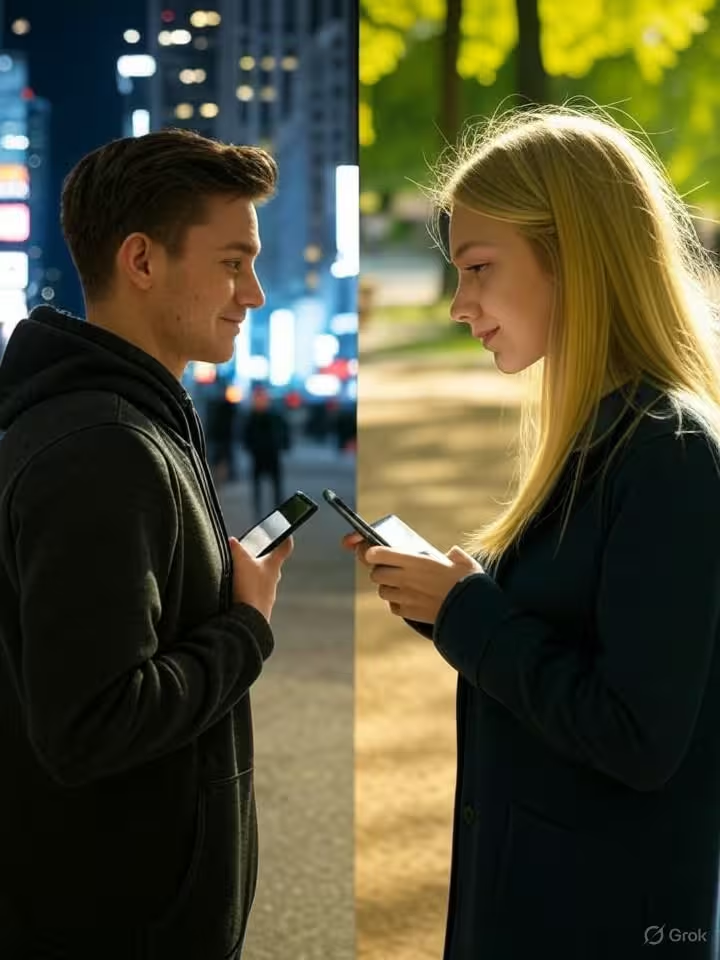
In the context of sugar dating, where physical presence is often an important component of the connection, this limitation is felt most acutely. Fancy dinners, carpools, quality face-to-face time - central elements of many sugar relationships - are reduced to meetings planned weeks in advance and limited windows of time.
In addition, the Latin American cultural context adds specific layers. In societies where «what people will say» still weighs heavily-especially in medium-sized cities or more traditional settings-explaining a long-distance relationship with someone no one knows can generate family and social scrutiny. Maintaining appropriate discretion becomes both easier (no one sees you with that person) and more difficult (travel absences raise questions).
On the other hand, digital tools have greatly facilitated these connections. WhatsApp, video calls, instant messaging-all of these allow for fluid communication between encounters. But the screen has obvious limits: it does not replace physical contact, it does not capture nuances that only presence reveals, and it can create an idealized version of the other that reality then confronts.
The specific obstacles you will face
Let's be straightforward about the real challenges. They are not insurmountable, but to ignore them would be naïve.
The economic factor: Flights within Latin America are not cheap, especially in high season or on short notice. A trip from Mexico City to Buenos Aires can cost between $400-800 USD round trip. If you plan to see you on a monthly basis, we are talking about a significant annual budget for transportation alone, not counting lodging, meals and activities. This cost generally falls more on the sugar daddy, but it represents a considerable investment that must be sustainable.

Time logistics: Coordinating agendas remotely is more complex than locally. Both have jobs, social commitments, family responsibilities. Finding 3-4 day windows where you can both devote time to the meeting requires advance planning and flexibility. Last-minute changes - unavoidable in real life - become more costly and frustrating when flights are involved.
Communicative attrition: Keeping a relationship alive exclusively through screens requires sustained effort. For the first few weeks, the novelty energizes conversations. After months, maintaining the same communicative intensity can feel like work. Video calls that were once exciting become routine. Messages that once generated anticipation become obligation.
Trust to the test: Without the possibility of regular physical presence, trust is built exclusively on communication and consistency. You cannot verify anything beyond what the other tells you. This can generate insecurities, especially in more anxious personalities or in contexts where previous experiences have left scars. Building a lasting relationship distance requires levels of trust that some people simply cannot sustain.
Cultural differences amplified: Although we share language (mostly) and certain cultural roots, the differences between Latin American countries are substantial. What is normal in Argentina may be strange in Mexico. Colombia's social codes differ from those of Chile. These differences, which in local relationships are negotiated gradually with constant exposure, in long-distance relationships may surprise and generate friction when you finally spend time together.
The advantages that do exist
It's not all obstacles. Long distance sugar dating relationships offer genuine benefits for the right people.
Independence preserved: If you value your personal space and routine, distance can be an ally. There is no expectation to see each other constantly, to show up at every social event, to integrate daily lives immediately. Everyone maintains his or her own independent life and meetings become special events, not routine.
Expanded pool of connections: Limiting yourself to your city drastically reduces your options. Opening your radar to all of Latin America exponentially multiplies your chances of finding someone genuinely compatible. That ideal person may be in another city or country, and without openness to distance, you would never meet them.
In-depth communication: The impossibility of relying on physical presence forces the development of stronger communication skills. Conversations tend to be more intentional, more revealing. Verbal intimacy that in local relationships sometimes takes time to develop, here is accelerated by necessity. You get to know each other's minds and personalities in ways that physical presence sometimes masks.
Intensified meetings: When they finally see each other, their time together is valued differently. It's not just another Tuesday; it's the weekend you've been planning for weeks. This intensification can create more memorable experiences and deeper connections during encounters, but it can also create pressure to make the most of it.
Geographic exploration: Mutual visits become opportunities to get to know new cities, new countries. Your meetings can be in Cartagena one month, in Buenos Aires the next, in Cancun the next. This geographical variety adds an adventurous dimension that purely local relationships do not have.
Expanded options
Limiting yourself to your city drastically reduces the pool of compatible connections. Opening your radar to all of Latin America multiplies the chances of finding someone genuinely like-minded. That ideal person may be thousands of miles away.
Independence preserved
Everyone maintains their routine, friendships and projects without the pressure of constant availability. Meetings become special events, not routine. For those who value their autonomy, distance can be an ally rather than an obstacle.
Deep communication
Without the easy recourse of physical presence, conversations tend to be more intentional and revealing. Verbal intimacy develops out of necessity, creating emotional connection that in local relationships sometimes takes longer to appear.
Practical strategies to make it work
If you decide to move forward with a long-distance relationship, these strategies significantly increase your chances of success.
Intentional, non-reactive communication
Communication at a distance requires intention. It's not about answering messages when they come in, but about creating dedicated spaces to genuinely connect. This means establishing routines: perhaps a 30-45 minute video call every two or three days where both of you are truly present, not distracted by other things.
Messages during the day have their place-they keep the connection alive between more substantive conversations-but they are no substitute for deeper contact. A «how's your day going?» is fine; relying exclusively on that doesn't work. Quality trumps quantity: better one connected conversation a week than shallow daily chats for the sake of compliance.
Use video calling whenever possible. Text removes too much nuance - tone, facial expression, emotional context - and is fertile ground for misunderstanding. Voice adds context; video adds intimacy. For important conversations, especially if they involve sensitive topics, always prioritize video over text.
Face-to-face meetings: quality over frequency

It is recommended to see each other at least every 4-8 weeks if resources permit. Less frequent and the connection tends to cool; physical presence is necessary to keep the chemistry alive. But the quality of those encounters matters more than the exact frequency.
Plan memorable experiences, not just time together. A well-designed weekend - with activities you both enjoy, spaces for deep conversation, and moments of intimacy - is worth more than rushed meetings to meet quotas. Consider rotating destinations: one month in his city, another in yours, perhaps a third in a neutral location you both want to get to know.
But be realistic about expectations. When you have only 48-72 hours together after weeks apart, there can be pressure for everything to be perfect. It won't be. There will be jet lag, travel fatigue, readjustment period to each other's presence. Anticipate this and give it space. Perfection is the enemy of the good.
Clear expectations from the outset
This point is critical and many avoid it out of discomfort. What does everyone expect from this connection? Is it something that could eventually become face-to-face, or are you both happy to keep it that way indefinitely? Is there exclusivity or is it something more open-ended? How will travel costs be handled?
These initially awkward conversations save considerable drama later. In Latin American cultures, where direct confrontation is sometimes avoided out of politeness, these talks can feel strange. But they are necessary. Understand the specific dynamics of sugar dating includes recognizing that explicit clarity is more important here than in conventional relationships.
In addition, expectations should be reviewed periodically. What worked at month two may no longer work at month eight. Circumstances change: new jobs, moves, changes in financial availability. Keep the conversation open and adjust as needed.
Remote trust management
Trust in long distance relationships is built differently. You don't have constant visual verification, you can't «drop in» to surprise him, you don't know his daily environment first hand. It all depends on what the other communicates and your willingness to believe it.
This requires two things: proactive transparency on both sides and conscious management of one's own insecurities. Transparency means willingly sharing information about your life, not because you are asked but because you understand that distance creates gaps that imagination fills - often negatively. Insecurities are normal, but if they dominate your state of mind between encounters, perhaps distance is not for you.
Clear agreements about exclusivity (or lack thereof) help enormously. In sugar dating, exclusivity is not automatic as in conventional relationships. If you expect exclusivity, communicate it explicitly. If you prefer something more open, too. Ambiguity is a recipe for disaster in long distance relationships.
Signs that it is not working
Not all long-distance relationships are destined for success, and recognizing this early saves time and emotional energy. Pay attention to these signs:
Unilateral effort: If you are constantly the one initiating conversations, proposing plans to meet, and adjusting your schedule, there is probably no real reciprocity. Mutual interest should be evident in actions, not just words. If you feel like you're chasing while the other simply responds, it's time to reconsider.
Communication as an obligation: When video calls feel like to-dos instead of anticipated moments, something is wrong. Distance shouldn't turn connection into forced labor. If you're constantly looking for excuses to cut conversations short or postpone them, ask yourself honestly why.
Meetings that do not materialize: If after several months there are no concrete plans to see each other, or if planned meetings are constantly cancelled, one or both parties are probably not truly committed. Words are cheap; actions-especially those that require investment of time and money-reveal real intentions. Assess compatibility includes whether both are willing to invest tangible resources.
Increasing disconnection between meetings: If every time you see each other you have to «recognize» each other from scratch, if intimacy is not maintained between meetings, if you feel like you are talking to a familiar stranger, distance is winning. Successful long-distance relationships maintain emotional continuity even when they go weeks without seeing each other physically.
Give it enough time to evaluate - three to six months with at least two or three face-to-face meetings - but not infinite. If after that period the negative signals persist, it is probably time to accept that this modality does not work for this specific connection.
The role of digital platforms
Platforms such as Sugar Daddy Latam have greatly facilitated these cross-border connections. They offer spaces where people from different countries can connect with ease, expanding possibilities that simply did not exist before. A profile in Buenos Aires can connect with someone in Mexico City in ways that would have been unthinkable a decade ago.
However, these platforms also facilitate idealization. The screen can hide as much as it reveals, and it's easy to build a mental image of the other that reality then confronts. Use these platforms as a starting point, but invest in really getting to know the person beyond the digital profile. Video calls before the first face-to-face meeting, substantive conversations about expectations and values, reasonable verification that the person is who they say they are.
The accessibility these platforms offer also means there are more options available, which can make it difficult to commit to a single connection. The «there's always something better» mentality is the enemy of long-distance relationships, which require sustained investment to work. If you're not willing to genuinely focus on one connection, perhaps long-distance isn't for you.
The honest answer: is it worth it?
After all this analysis, the answer to whether long distance sugar dating relationships are worth it is: depends entirely on your specific situation.
It is probably worth it if: You value your independence and do not want a high-frequency relationship. You have the financial resources to sustain regular travel. You are a strong communicator and enjoy deep conversations. You do not have severe anxious tendencies that distance would amplify. You are open to eventually closing the distance or keeping it indefinitely if it works. Maintaining genuine interest distance learning is possible, but requires specific personal characteristics.
Probably not worth it if: You need frequent physical presence to feel connected. Insecurity overpowers you when you don't have constant verification. Your resources do not allow for regular travel without significant sacrifices. You are looking for a relationship that evolves into cohabitation and there is no realistic possibility of closing the distance. You tend to idealize and then get disappointed when reality does not match.
The truth is that Latin America is huge and diverse. The connections that can arise between distant cities bring richness that purely local relationships sometimes do not. But they also bring additional complexity that not everyone is equipped to handle.
If you decide to try, do it with your eyes open. Know the obstacles before you face them. Set clear expectations from the start. Invest in quality communication. Plan memorable meetings. And above all, be honest with yourself about whether this modality fits what you really need from a relationship. Distance can be a bridge or a barrier-which one it is depends largely on how you handle it.
Frequently Asked Questions
There is no universal rule, but a meaningful 30-60 minute video call every two or three days, supplemented with casual messages in between, works well. The important thing is that both of you are genuinely present during those conversations, not distracted by other things. Quality trumps quantity: better one truly connected conversation a week than daily shallow chats out of obligation. Set the pace together and adjust it as it works for both of you.
It is advisable to see each other at least every 4-8 weeks if resources permit. Less frequently, the connection tends to cool and the physical component of the relationship becomes too weak. But quality matters more than exact frequency: a well-planned weekend every month and a half can be more valuable than rushed getaways every three weeks. Prioritize special times like birthdays or significant dates to be together.
In the sugar dating context, typically the sugar daddy covers most of the travel costs, especially when she travels to him. However, each relationship has its own dynamics and this should be explicitly discussed at the outset. Some couples alternate who travels; others have arrangements where he always covers flights and accommodations. The important thing is that the agreement is clear and sustainable for both, avoiding resentment or uncommunicated expectations.
Yes it is possible, but it requires explicit agreements and solid trust. In sugar dating exclusivity is not automatic as in conventional relationships, so it must be discussed openly. The distance adds complexity because there is no physical verification possible; everything depends on mutual word and transparency. Some couples opt for progressive exclusivity: they start open and after a certain level of connection they move towards exclusivity. The bottom line is honesty: if you can't or don't want to be exclusive, communicate it clearly.
Three to six months with at least two or three face-to-face meetings in that period. This time allows you to overcome the initial idealization phase and see how you really work together in different contexts. If after six months communication is still stilted, meetings are constantly cancelled, or you feel you invest much more than the other, it's probably time to reconsider. On the other hand, if the connection deepens and you're both genuinely enthusiastic, it's worth continuing to invest.


 Español
  Português do Brasil
  English
One comment:
Vane1997
25 February, 2025 at 8:52 pm
This article offers a clear and balanced perspective on Sugar long-distance relationships, showing both their charms and their challenges. It discusses how this type of relationship can be exciting and rewarding, but also raises the need to evaluate personal expectations and how to manage distance.
What stands out the most is how it highlights the **intensity** of the meetings, which are experienced with greater excitement due to the anticipation. The idea that each date becomes a special event, with travel, unique experiences and memorable moments, is an undeniable advantage for many people. In addition, the **discretion** and **privacy** that a long-distance relationship offers are very attractive factors for those looking to keep their personal lives separate from their Sugar relationship.
On the other hand, the article also points out the **challenges** that come with lack of frequent contact, such as **difficulty in strengthening the bond** or the risk of the relationship **cooling** over time. The logistics and planning of meetings can be complicated, and maintaining exclusivity can also be a challenge in long-distance arrangements.
In summary, this article invites us to reflect on what we are really looking for in a Sugar relationship. If you want more **independence** and **freedom**, a long-distance relationship may be an excellent option. If, on the other hand, what you are looking for is a more constant and deeper connection, with frequent encounters and greater closeness, perhaps a local relationship is more appropriate.
Finally, she reminds us that the most important thing is to **set clear expectations** from the beginning, making sure that both parties are committed to the relationship. Whatever the choice, the essential thing is to enjoy the process and be in tune with what we really want out of the experience.